Unit price
€44.50From 3
€42.00 -6%
Delivered in 24h/ 48h
Need help? +33 (0)4 94 23 68 35
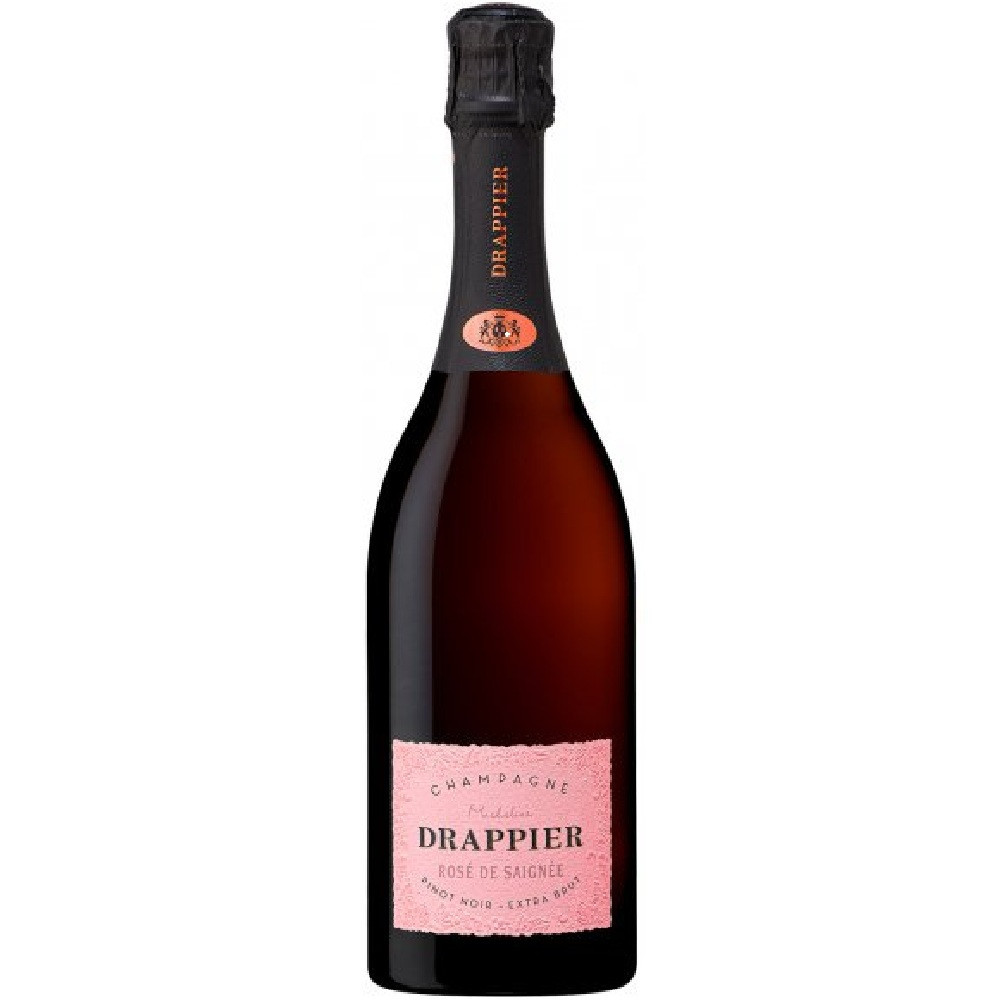
Rosé de Saignée showcases Pinot Noir from Urville, rooted in the Kimmeridgian limestone soils of the Côte des Bar. Two days of cold pre-fermentation maceration naturally give the wine its colour and intense fruit character, while a small proportion aged in foudre adds depth. Red berries, violet and spice lead to a satin-textured, expressive palate balanced by freshness and a delicate touch of liquorice on the finish.
The sommelier info
A rosé Champagne with genuine personality, offering greater texture and intensity than a classic blended rosé while retaining impressive freshness. Drappier preserves remarkable purity of fruit, with expressive Pinot Noir and enough structure to move effortlessly from aperitif to the dining table.
This wine is served with
Champagne Drappier Rosé de Saignée pairs beautifully with lightly cooked salmon, tuna tataki, grilled lamb chops, pink duck breast or a lightly sweetened strawberry salad; serve at 7-8°C and allow it to warm slightly in the glass to reveal its full vinous character.
Champagne Drappier Rosé de Saignée in details
Frequently purchased together
The domain
Champagne Drappier is above all a family history that has lasted for nearly two hundred years. Owner of 55 hectares and using 50 hectares in associated contracts, Drappier uses its know-how to produce high quality champagnes. Drappier is located in Urville, home of the Pinot Noir.
The origins of the House of Drappier go back to the 17th century, when Saint-Bernard founded the Abbey of Clairvaux and built the family cellars in 1152. These so-called Cistercian cellars are the pride of the Drappier family. The ancestors were drapery merchants in Reims and the family business turned to the vine in 1808 on the initiative of François Drappier. Georges Collot, Michel Drappier’s maternal grandfather, allowed a big development of the company by replanting Pinot Noir in 1930. Indeed, this grape variety is emblematic of the Côte des Bar and will really define the identity of Champagne Drappier. Champagne being a passion passed on from generation to generation, Michel Drappier has been running the company since 1979. His father André, now quite old, is also still present, with about sixty harvests to his credit. Today, Hugo and Charline Drappier have joined the adventure and bring their know-how.
Approximately one third of Drappier’s vineyard is cultivated organically, the flagship grape varieties of the Champagne region are honored with a nice dominance of Pinot Noir (about 70%) and varieties that are more rarely found such as Arbane, Petit Meslier or Blanc Vrai. A real revolution at the beginning, Drappier’s signature is based on its choice to use very little dosage in its cuvées. Indeed, a Brut Nature cuvée has been created as well as its "No Sulphites Added" version which contains only the sulphites naturally created during the champagne making process. The House of Drappier is the only one to design each of its containers, from the half-bottle to the melchisédech (30 liters) with other rare formats such as the primat (27 liters). The riddling always takes place in its original bottle and is still done manually in the cellars of Champagne Drappier.
The House Drappier has a wide range of Champagnes: from the classic Brut Carte d’Or, which is the perfect representation of Pinot Noir and its aromatic finesse, to the original Brut Nature and its namesake without added sulfur, to its top-of-the-line cuvée La Grande Sendrée, which was created after a fire in an 18th century bottle. To highlight the rare grape varieties of the Champagne region, a cuvée has been developed: Quattuor Blanc de Quatre Blancs: a blend of Chardonnay, Petit Meslier, Arbane and Blanc Vrai. There is also the Charles de Gaulle cuvée among the Drappier collection: it pays tribute to this particular customer of the Drappier Champagne, who strongly appreciated Pinot Noir. Clarevallis, a cuvée created by Hugo Drappier, joined the range only a few years ago.