Gevrey-chambertin
Gevrey-Chambertin is one of Burgundy's most emblematic appellations. Located in the northern part of the Côte de Nuits, this vineyard devoted exclusively to Pinot Noir includes Village wines, 26 Premier Cru climats and, around the village, nine of Burgundy's most prestigious Grand Crus.
This concentration of outstanding terroirs explains part of its reputation, but it does not define Gevrey-Chambertin on its own. Depending on the climat, altitude, exposure, vintage and producer, the wines can range from fruit-driven Pinot Noir in their youth to deep, structured cuvées capable of developing for many years.
A major vineyard of the Côte de Nuits
Gevrey-Chambertin lies south of Dijon, in the northern part of the Côte de Nuits.
The Village appellation area covers the communes of Gevrey-Chambertin and Brochon and extends over slightly more than 400 hectares, including around 80 hectares classified as Premier Cru.
The vines occupy different levels of the slope, with predominantly eastern and south-eastern exposures. Depending on the sector, the soils combine limestone, marl, scree and red silt.
This geological diversity is essential. Some areas favour greater finesse and tension, while others bring more body and firmness.
The appellation therefore does not correspond to a single profile. As is often the case in Burgundy, a few hundred metres can be enough to noticeably change the expression of Pinot Noir.
Pinot Noir, the only grape variety in Gevrey-Chambertin
Gevrey-Chambertin produces only red wines from Pinot Noir.
In its youth, the grape can express aromas of cherry, strawberry, blackberry and other red or dark berries, sometimes accompanied by floral notes.
With age, the profile develops towards more complex nuances of liquorice, spice, leather, woodland and more savoury or gamey notes.
Gevrey-Chambertin is often associated with a certain degree of power. There is some truth behind this reputation, particularly because the wines can show firmer tannic structures than those of certain neighbouring appellations.
However, as with Pommard, reducing Gevrey-Chambertin to power would be far too simplistic. The finest examples combine structure and finesse, with firm yet precise tannins and a texture that can become remarkably silky with age.
Village and Premier Cru: understanding the 26 climats
Bottles may simply carry the Gevrey-Chambertin appellation or the Gevrey-Chambertin Premier Cru designation.
The Premier Crus correspond to 26 precisely delimited climats.
Among the most renowned names are Clos Saint-Jacques, Les Cazetiers, Lavaut Saint-Jacques, Estournelles-Saint-Jacques, Combe au Moine, Champeaux, Aux Combottes and Petite Chapelle.
A climat is not a brand or a cuvée created by a producer. It refers to a historically delimited vineyard area with its own particular soil, exposure and position.
Two Gevrey-Chambertin Premier Cru wines can therefore have noticeably different profiles.
Premier Cru vineyards located higher on the slope often have relatively shallow limestone soils. Lower down, variations in marl, scree and silt create different balances between finesse, structure and depth.
Chambertin and the 9 Grand Crus of Gevrey
Gevrey-Chambertin has a remarkable feature: the commune is home to nine Grand Crus.
They are Chambertin, Chambertin-Clos de Bèze, Chapelle-Chambertin, Charmes-Chambertin, Griotte-Chambertin, Latricières-Chambertin, Mazis-Chambertin, Mazoyères-Chambertin and Ruchottes-Chambertin.
These wines must, however, be clearly distinguished from the Gevrey-Chambertin appellation itself.
Chambertin is not a “Gevrey-Chambertin Grand Cru”. Each Grand Cru is a separate appellation in its own right. The official Gevrey-Chambertin hierarchy therefore ends at Premier Cru level, even though these nine Grand Crus are located within the commune.
This distinction is important when understanding Burgundy labels and the region's classification system.
The connection between the village and Chambertin is nevertheless both historic and profound. In 1847, Gevrey became the first Burgundy wine village authorised to add the name of its most prestigious cru to its own, becoming Gevrey-Chambertin.
Village lieux-dits matter too
The interest of Gevrey-Chambertin does not begin only at Premier Cru level.
Many Village wines can carry the name of a specific lieu-dit. These indications provide a more precise reading of terroir without changing the appellation level.
Within the Infinivin selection, examples include Les Évocelles from Domaine Philippe Livera and En Champs from Olivier Guyot.
These cuvées remain Gevrey-Chambertin Village wines, but their parcel-specific origins highlight a particular area of the vineyard.
This makes them particularly interesting for wine lovers who want to explore Gevrey-Chambertin without necessarily moving directly to Premier Cru: the Village level itself covers a considerable diversity of terroirs.
Philippe Livera, Olivier Guyot and Thierry Mortet at Infinivin
The Infinivin selection makes it possible to explore this diversity through several estates.
Domaine Philippe Livera is represented in particular by a Gevrey-Chambertin Clos Village and Les Évocelles.
Olivier Guyot provides an opportunity to explore both Village level with En Champs and Premier Cru level with Les Champeaux.
Domaine Thierry Mortet offers a third interpretation of the appellation.
The selection therefore allows several producer styles, vineyard origins and hierarchy levels to be compared without reducing Gevrey-Chambertin to its Grand Crus alone.
Gevrey-Chambertin and Morey-Saint-Denis: one border, several expressions
To the south, Gevrey-Chambertin directly borders Morey-Saint-Denis.
Both appellations belong to the Côte de Nuits, are devoted entirely or overwhelmingly to great Pinot Noir wines and possess a remarkable concentration of Premier and Grand Crus.
Comparing them simply through an opposition between power and finesse would nevertheless be reductive.
Gevrey-Chambertin certainly has a reputation for structure and depth, but some terroirs can produce particularly elegant wines. Likewise, Morey-Saint-Denis can produce highly structured Pinot Noir.
Climat, producer and vintage ultimately provide more precise guidance than generalisations applied to an entire village.
Does Gevrey-Chambertin always need time in the cellar?
Ageing potential is one of the appellation's major strengths.
Young wines can offer intense fruit alongside a still-present tannic structure. After a few years, the tannins gradually soften and the aromas develop into more complex registers.
A balanced Village Gevrey-Chambertin can already evolve successfully for several years, while the more structured Premier Crus are often capable of much longer ageing.
The strongest vintages and most ambitious terroirs can develop for decades under good storage conditions.
That does not mean every bottle needs to be kept for years.
Some cuvées are highly enjoyable in their youth thanks to the quality of their fruit. When deciding when to open a bottle, it is better to consider the producer, climat, vintage and structure of the cuvée rather than applying the same ageing period to every Gevrey-Chambertin.
At the table: structure without sacrificing finesse
The structure of Gevrey-Chambertin allows it to accompany richly flavoured dishes.
Young cuvées pair particularly well with beef, lamb, duck and roasted meats.
More mature wines, once the tannins have softened and woodland aromas begin to emerge, work naturally with game, mushrooms and slow-cooked dishes.
Characterful Burgundy cheeses such as Époisses or Cîteaux can also accompany more mature cuvées.
Above all, Gevrey-Chambertin's reputation rests on its ability to combine qualities that are rarely brought together with such consistency: depth and finesse, structure and silkiness, the pleasure of fruit in youth and the complexity acquired with age.

Filters
Sort
Top Wines estates


- Out-of-Stock
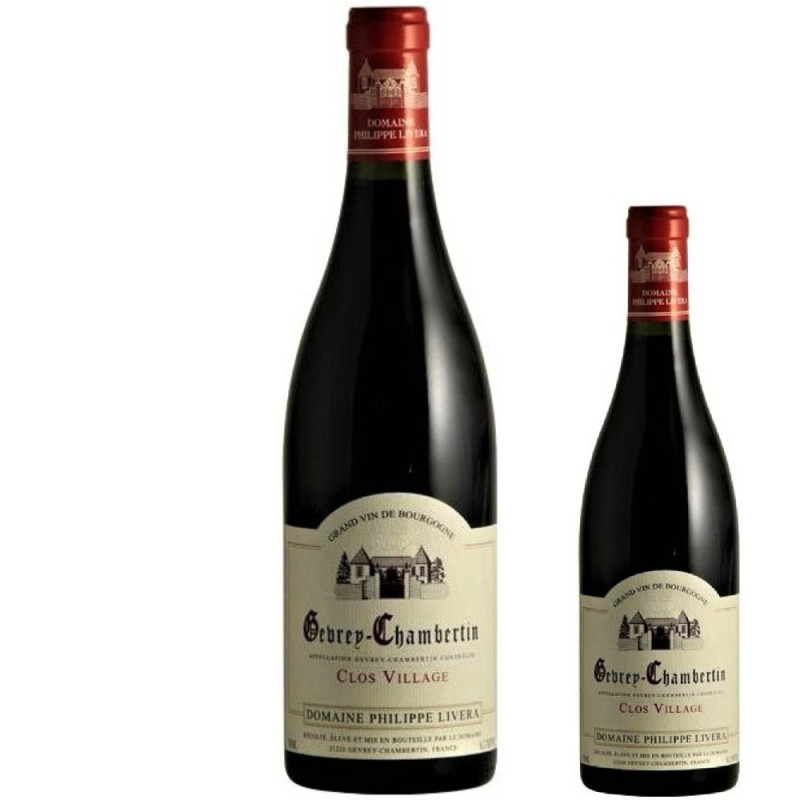
Magnum Domaine Philippe Livera Gevrey Chambertin Clos Village 2023
Unit price
€172.00From 2
€154.80 -10%